
Peptide Research: Investigating Circadian Rhythms and Sleep Modulation
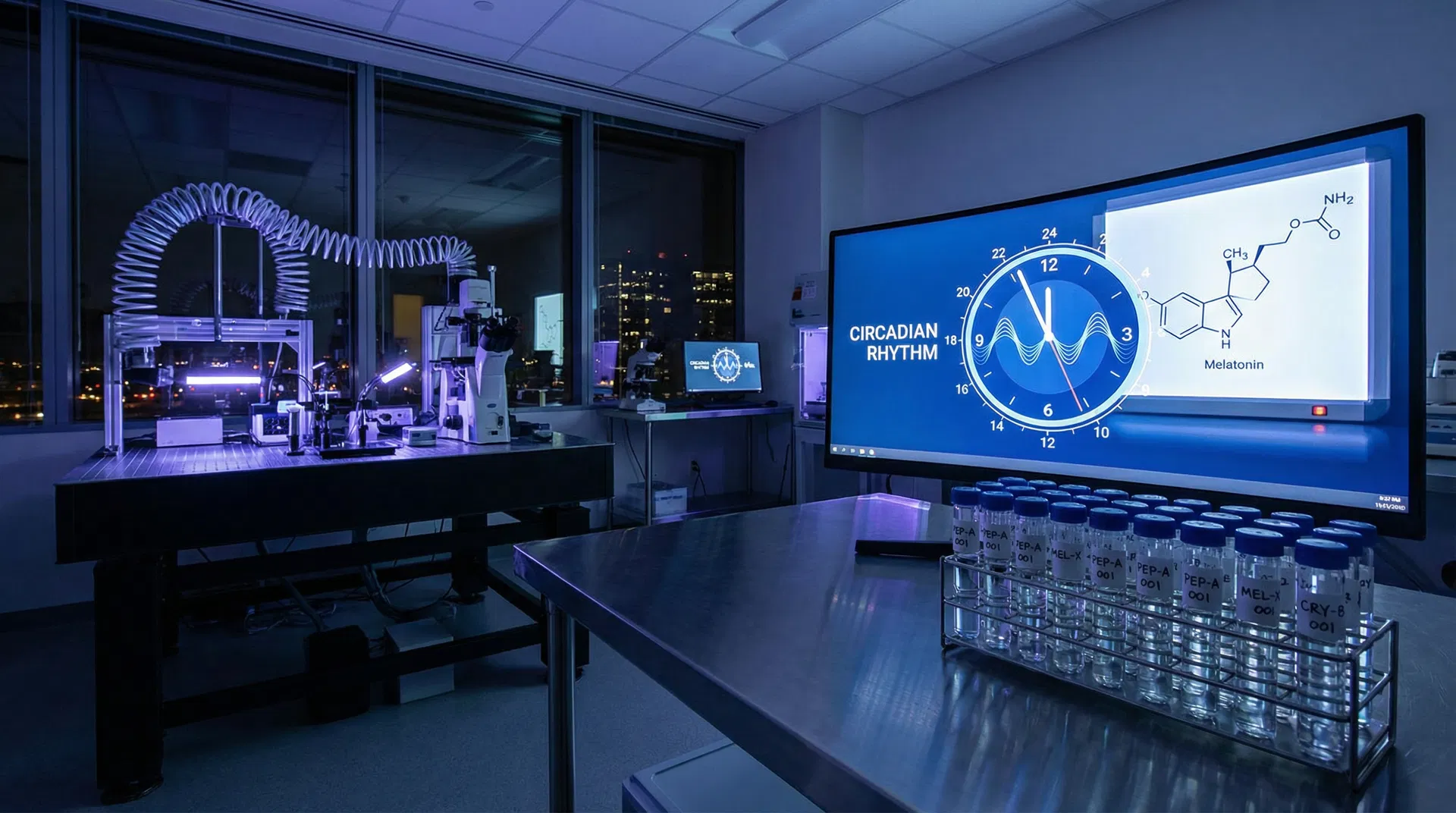
Peptides are emerging as significant modulators of circadian rhythms and sleep architecture in preclinical and laboratory settings. This article explores how specific peptides influence sleep patterns and circadian regulation in research contexts.
Research Use Only. This article is for informational and research purposes only and does not constitute medical advice. Always consult a qualified healthcare professional before making any health decisions.
Peptide Research: Investigating Circadian Rhythms and Sleep Modulation
The intricate relationship between various biological processes and the sleep-wake cycle is a critical area of scientific inquiry. Among the many compounds under investigation, peptides have emerged as significant modulators of circadian rhythms and sleep architecture in preclinical and laboratory settings. This article explores the current understanding of how specific peptides influence sleep patterns and circadian regulation, emphasizing their role in research contexts rather than for human consumption.
The Role of Peptides in Circadian Regulation
Circadian rhythms, the approximately 24-hour cycles that regulate many physiological processes, are profoundly influenced by a diverse array of peptides. Research indicates that certain peptides act as signaling molecules within the central nervous system, impacting the "master clock" located in the suprachiasmatic nucleus (SCN) of the hypothalamus [1]. For instance, studies have identified numerous circadian-related peptides within the SCN, suggesting their involvement in fine-tuning these essential biological clocks [2]. The modulation of melatonin production, a key hormone in sleep-wake cycles, is also influenced by peptides like Epitalon and Pinealon, which target the pineal gland [3, 4]. These findings highlight the potential of peptides as research tools to unravel the complexities of circadian biology.
Peptides and Sleep Architecture in Preclinical Models
Beyond circadian regulation, specific peptides have been shown to directly impact sleep architecture in various preclinical models. Delta Sleep-Inducing Peptide (DSIP), for example, has been extensively studied for its influence on sleep cycles, demonstrating improved sleep efficiency and reduced sleep latency in some research paradigms compared to placebo [5]. Conversely, stress-related peptides such as Pituitary Adenylate Cyclase-Activating Polypeptide (PACAP) have been observed to cause long-lasting sleep disruptions, mimicking stress-induced sleep disturbances in animal models [6]. This differential impact underscores the nuanced roles peptides play in both promoting and disrupting sleep, offering valuable insights for understanding sleep disorders.
Summary of Key Peptides and Their Research Implications
| Peptide Name | Primary Research Focus | Observed Effects (Preclinical) | | :----------- | :--------------------- | :----------------------------- | | DSIP | Sleep induction | Improved sleep efficiency, reduced sleep latency [5] | | Epitalon | Circadian rhythm | Regulates melatonin, aligns circadian rhythm [3] | | Pinealon | Circadian rhythm | Targets pineal gland, controls circadian rhythms [4] | | PACAP | Stress response | Long-lasting sleep disruptions [6] | | Collagen Peptides | Sleep quality | Reduced sleep fragmentation, enhanced sleep quality [7] |
Considerations for Peptide Research Protocols
When designing research protocols involving peptides and sleep, several critical factors must be considered. The timing of peptide administration in relation to an organism's natural circadian rhythm can significantly alter experimental outcomes. Researchers must meticulously control environmental factors, such as light-dark cycles, to ensure the integrity of their findings. Furthermore, the purity and precise dosage of research-grade peptides are paramount for reproducible results. It is crucial to remember that all research involving these compounds should be conducted in a controlled laboratory environment, strictly adhering to ethical guidelines and regulatory standards for preclinical research.
Compliance Notice
All compounds supplied by Pure Peptides are for laboratory and preclinical research use only. Not for human consumption.
References
[1] Nature. (n.d.). Circadian rhythm signalling peptides and proteins. Available at: https://www.nature.com/subjects/circadian-rhythm-signalling-peptides-and-proteins [2] Lee, J. E., Zamdborg, L., Southey, B. R., et al. (2013). Quantitative peptidomics for discovery of circadian-related peptides from the rat suprachiasmatic nucleus. Journal of Proteome Research, 12(10), 4619-4628. Available at: https://pubs.acs.org/doi/abs/10.1021/pr300605p [3] Kenton Bruice MD. (2025, May 1). Best Peptides for Sleep: What to Know Before You Try Them. Available at: https://kentonbruicemd.com/best-peptides-for-sleep-what-to-know-before-you-try-them/ [4] The Gajer Practice. (2025, July 31). How Peptides Are Transforming Rest and Recovery. Available at: https://thegajerpractice.com/blog/how-peptides-are-transforming-rest-and-recovery/ [5] Bes, F., et al. (1992). Effects of delta sleep-inducing peptide on sleep of chronic insomniacs. European Neurology, 32(3), 129-134. Available at: https://pubmed.ncbi.nlm.nih.gov/1299794/ [6] Foilb, A. R., et al. (2024). Differential effects of the stress peptides PACAP and CRF on sleep architecture in mice. Nature Communications, 15(1), 1-15. Available at: https://www.nature.com/articles/s44277-024-00003-y [7] Thomas, C., et al. (2023). Collagen peptide supplementation before bedtime reduces sleep fragmentation and enhances sleep quality in physically active individuals. Journal of the International Society of Sports Nutrition, 20(1), 1-12. Available at: https://pmc.ncbi.nlm.nih.gov/articles/PMC10799148/