
How to Read a Peptide Certificate of Analysis (COA): What Actually Matters in 2026
A COA is the only document that tells you what is actually inside the vial. This guide walks through every section — from HPLC chromatograms to mass spectrometry confirmation — and shows you exactly what separates a trustworthy document from a misleading one.
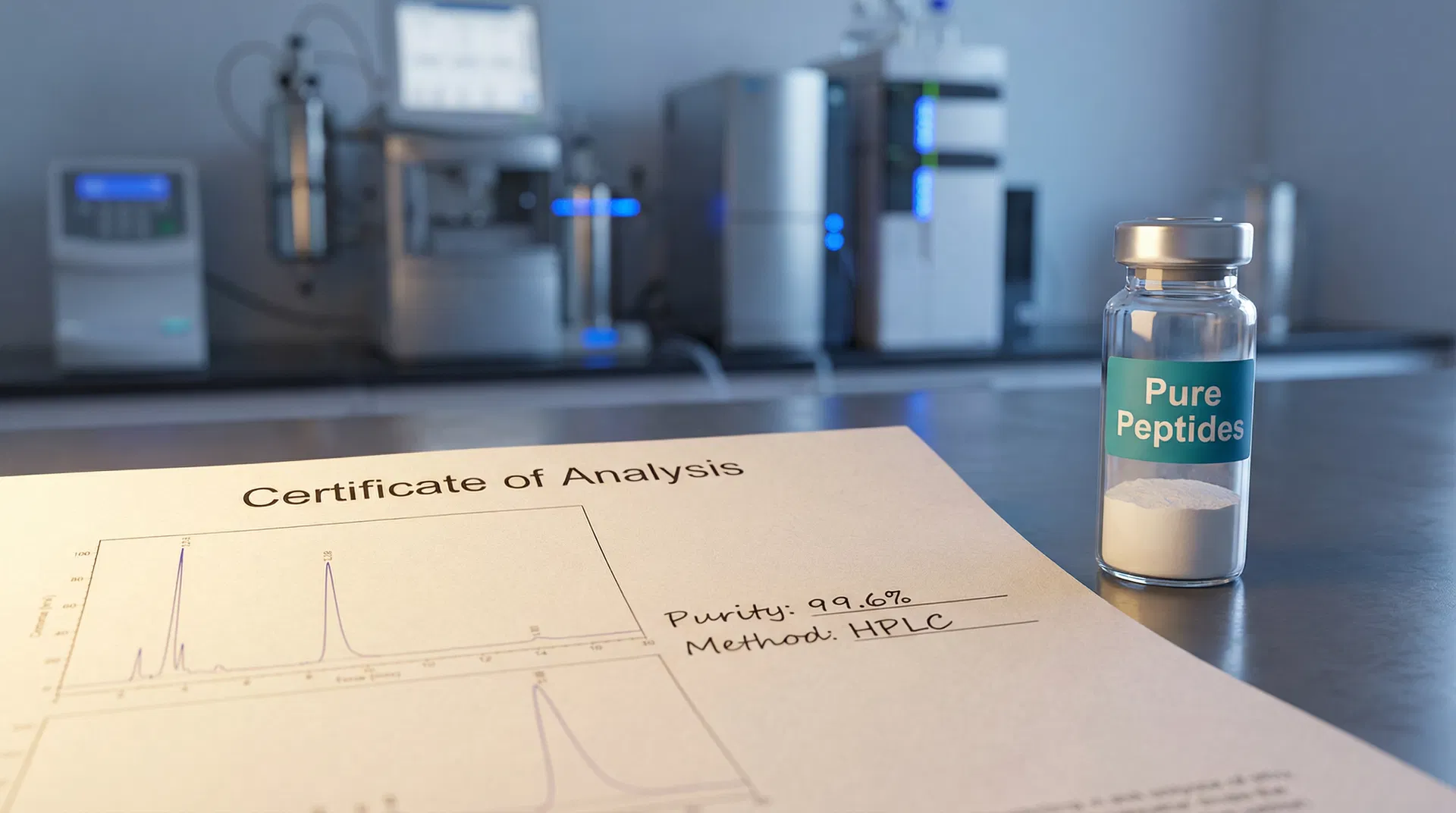
Research Use Only. This article is for informational and research purposes only and does not constitute medical advice. Always consult a qualified healthcare professional before making any health decisions.
Why COA Literacy Matters for Researchers
If you order research peptides without reading the Certificate of Analysis properly, you are essentially buying blind. A COA is the only document that tells you what is actually inside the vial, not just what the label says.
The problem is that most researchers either skip the COA entirely or glance at a single number without understanding what it represents. That single number, usually a purity percentage, only tells part of the story.
This guide walks you through every section of a peptide COA, explains what each figure means in practice, and shows you exactly what separates a trustworthy document from a misleading one.
What Is a Peptide Certificate of Analysis?
A Certificate of Analysis is a formal document issued by a laboratory that confirms the identity, purity, and quality of a specific batch of peptide compound. It is the primary quality assurance record for any research-grade peptide.
The word "batch-specific" is important here. A legitimate COA applies to one production batch, identified by a unique lot or batch number. It is not a generic document reused across multiple orders. When a supplier provides a COA without a batch number, that is a serious problem.
Suppliers like Pure Peptides issue a batch-specific COA with every order, confirming purity at 99.6% or above through HPLC verification. That specificity is what makes a COA useful rather than decorative.
The Key Sections of a Peptide COA
A well-structured COA contains several distinct sections. Each one answers a different question about the compound.
Product Identification and Batch Number
This section sits at the top of the document and includes the peptide name, molecular formula, molecular weight, batch or lot number, and the date of manufacture or testing.
You should always cross-reference the batch number on the COA with the batch number printed on your vial. If they do not match, the COA does not apply to what you received.
The molecular weight listed here also gives you a quick verification point. If you know the expected molecular weight of the peptide you ordered, a significant discrepancy in this field is an immediate warning sign.
HPLC Purity Data
High-Performance Liquid Chromatography (HPLC) is the standard method for measuring peptide purity. This section is often the most important part of the COA for research purposes.
HPLC works by separating the components of a sample as they pass through a column. The output is a chromatogram — a graph showing peaks that correspond to different compounds. The main peak represents your target peptide. Any additional peaks represent impurities.
Purity is expressed as a percentage of the total peak area that belongs to the main compound. A result of 99.6% means that 99.6% of the detected material is the target peptide. The remaining 0.4% includes residual solvents, synthesis byproducts, or other trace compounds.
For research-grade peptides, 98% is generally considered the minimum acceptable threshold. Anything below 95% is unsuitable for serious research. Suppliers who consistently report 99.6% or higher — as Pure Peptides does across its catalogue of 63+ compounds — are operating at the upper end of what is achievable in commercial peptide synthesis.
The COA should include the actual chromatogram or at minimum the retention time and peak area data. A purity figure without supporting data is not verifiable.
Mass Spectrometry Confirmation
HPLC tells you how pure the sample is. Mass spectrometry (MS) tells you whether the compound is actually what the label claims.
Mass spectrometry measures the mass-to-charge ratio of ionized molecules. For a peptide, this produces a molecular weight reading that you can compare against the theoretical molecular weight of the compound. If the values match within an acceptable tolerance (typically within 1 dalton for smaller peptides), the compound identity is confirmed.
This matters because a sample could theoretically be 99% pure but still be the wrong peptide. HPLC alone cannot distinguish between two peptides with similar structures. Mass spectrometry closes that gap.
Look for the observed molecular weight (or m/z value) and the theoretical molecular weight in this section. Both should be present, and the difference between them should be minimal.
Water and Acetate Content
Lyophilized peptide powders always contain some residual water and, depending on the synthesis process, residual acetate from the purification stage. These are not impurities in the traditional sense, but they affect the actual peptide content of the vial.
If a vial contains 5mg of material but 10% of that is water and 5% is acetate, the actual peptide content is closer to 4.25mg. This matters when you are calculating reconstitution volumes and dosing for research protocols.
A thorough COA will include Karl Fischer titration data for water content and ion chromatography or NMR data for acetate content. Not every supplier includes this level of detail, but its presence signals a higher standard of testing.
Appearance and Physical Characteristics
This section describes the physical state of the compound: typically a white to off-white lyophilized powder. It also notes solubility characteristics.
This section is less analytically significant than HPLC or MS data, but it serves as a basic quality check. If the COA describes a white powder and you receive something visibly discolored or clumped in an unusual way, that discrepancy is worth investigating before use.
What Purity Percentage Actually Means
Purity percentage is the figure most researchers focus on, and it is genuinely important. But it needs context.
A 99.6% HPLC purity figure means that 99.6% of the UV-absorbing material detected in the chromatogram is the target compound. It does not account for compounds that do not absorb UV light at the detection wavelength. This is why mass spectrometry confirmation is a necessary companion test, not an optional extra.
It also does not tell you the absolute amount of peptide in the vial. A vial labeled 5mg at 99.6% purity contains approximately 4.98mg of the target peptide. That is a negligible difference at research scale, but it illustrates that purity and quantity are separate measurements.
When comparing suppliers, look at both the purity figure and the testing method used to arrive at it. A supplier reporting 99% purity from an in-house test with no chromatogram is not equivalent to a supplier reporting 99.6% from an independent third-party lab with full data attached.
Red Flags to Watch For in a COA
Knowing what a good COA looks like makes it easier to spot a problematic one. Here are the specific things that should make you pause.
No batch number. A COA without a batch number cannot be tied to a specific production run. It may be a template document rather than a genuine test result.
No chromatogram or raw data. A purity figure without supporting data is unverifiable. Any supplier confident in their testing should be able to show the actual chromatogram.
Suspiciously round numbers. Real HPLC results rarely produce perfectly round figures like exactly 99.0% or exactly 100%. A result like 99.6% or 98.3% is more consistent with genuine measurement.
Missing mass spectrometry data. If the COA only includes HPLC and nothing else, you have purity information but no identity confirmation. Both tests together provide a complete picture.
Testing date older than the batch. If the testing date on the COA predates the batch manufacture date, that is a logical impossibility and suggests the document has been altered or fabricated.
No laboratory identification. The COA should name the laboratory that performed the testing, including contact information or an accreditation number. Anonymous testing cannot be independently verified.
Purity below 98%. For research applications, this is generally below the acceptable threshold. Some suppliers sell lower-grade material at a discount, but this should be clearly disclosed.
How to Verify a COA Is Legitimate
Reading a COA is one step. Verifying it is another.
The most direct method is to contact the testing laboratory listed on the document and ask them to confirm the result for the batch number provided. Accredited labs maintain records and can confirm whether a specific test was performed.
You can also send a sample for independent third-party testing. Several commercial labs offer peptide purity testing by HPLC and mass spectrometry. This adds cost and time, but for high-stakes research it provides certainty that no supplier document can fully replace.
At minimum, check that the laboratory named on the COA is a real, accredited facility. A quick search for the lab name alongside terms like "ISO 17025 accreditation" or "GLP certified" will tell you whether the organization has verifiable credentials.
Suppliers who make their COA process transparent — including batch-specific documentation, named laboratories, and accessible data — are generally operating with a higher degree of accountability. Each product at Pure Peptides ships with exactly this kind of documentation, giving you a concrete reference point for what a properly formatted COA looks like.
FAQs
What is a peptide Certificate of Analysis? A peptide Certificate of Analysis (COA) is a laboratory document that confirms the identity, purity, and physical characteristics of a specific batch of peptide compound. It typically includes HPLC purity data, mass spectrometry confirmation, and batch identification details.
What HPLC purity percentage is acceptable for research peptides? For research-grade peptides, 98% is generally considered the minimum acceptable purity. High-quality suppliers typically report 99% or above. Pure Peptides confirms purity at 99.6% or higher across its product range.
Why does mass spectrometry matter if HPLC already shows high purity? HPLC measures how much of the detected material is the target compound. Mass spectrometry confirms that the compound is actually the correct peptide. A sample can be highly pure but still be the wrong molecule. Both tests together provide complete quality confirmation.
How do I know if a COA is batch-specific? A batch-specific COA will include a unique lot or batch number that matches the number printed on your vial. If the COA has no batch number, or if the number does not match your vial, the document cannot be verified as applying to your specific order.
Can I independently verify a peptide COA? Yes. You can contact the laboratory named on the COA and ask them to confirm the test result for the listed batch number. You can also send a sample to an independent third-party lab for your own HPLC and mass spectrometry testing.
What does water content in a COA mean for my research? Residual water in lyophilized peptide powder affects the actual peptide content of the vial. If water content is 10%, a 5mg vial contains approximately 4.5mg of peptide. This matters when calculating accurate reconstitution volumes for research protocols.
What are the biggest red flags in a peptide COA? The main red flags are: no batch number, no chromatogram or raw data, missing mass spectrometry confirmation, a testing date that predates the manufacture date, no named laboratory, and purity figures below 98%.
Final Thoughts
Reading a peptide COA properly takes about five minutes once you know what to look for. Those five minutes can be the difference between reliable research data and results built on a compromised compound.
Focus on four things: batch number match, HPLC purity with supporting chromatogram data, mass spectrometry identity confirmation, and a named, verifiable testing laboratory. Everything else is secondary.
If you want a practical example of what a well-documented COA looks like in practice, browse the Pure Peptides catalogue and review the batch-specific documentation that ships with every research-grade compound. Use it as a benchmark when evaluating any other supplier.