
GHK-Cu Copper Peptide: The Science Behind the Skin-Regeneration Surge
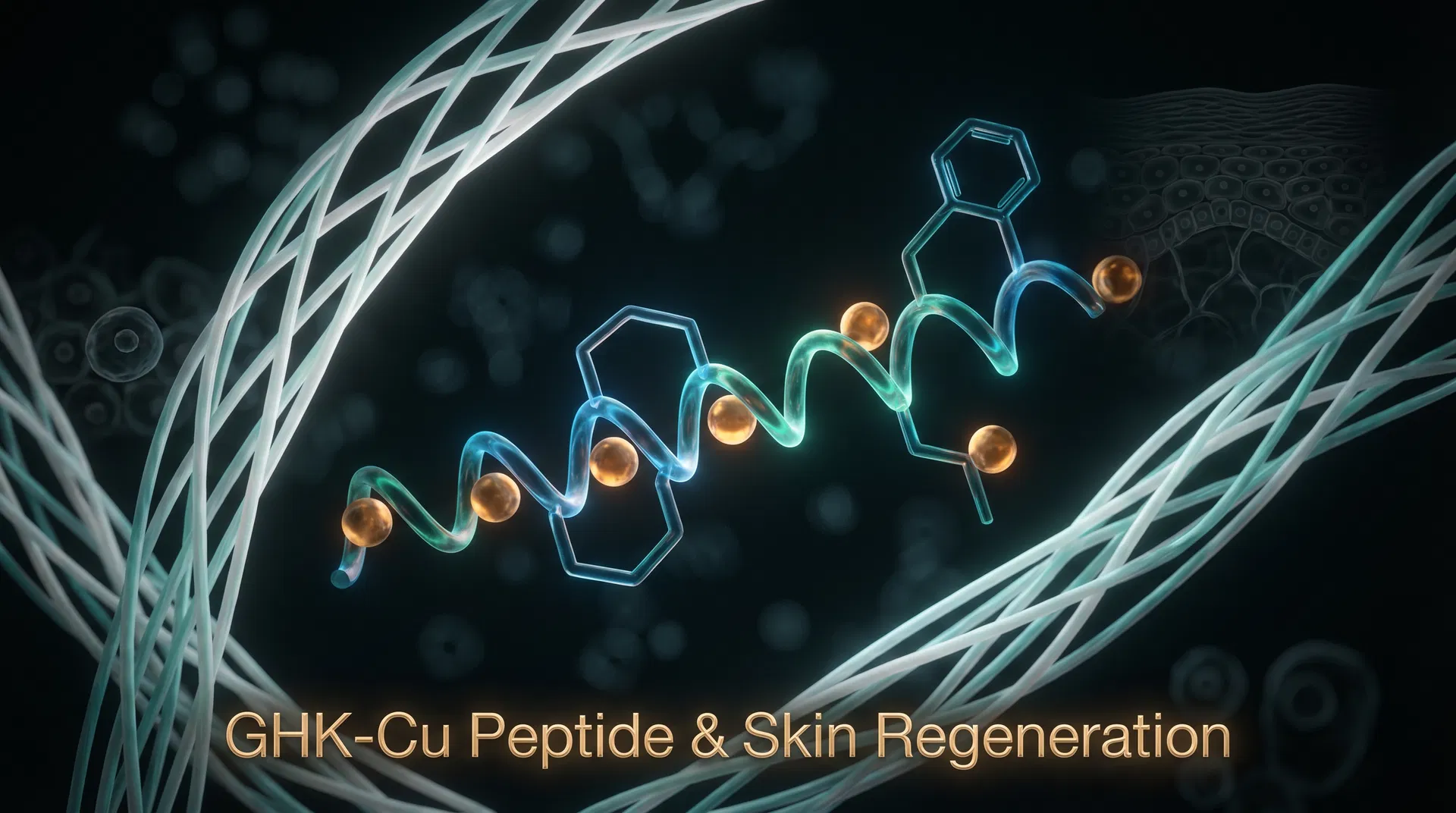
GHK-Cu is a naturally occurring tripeptide-copper complex that declines with age. Research has identified roles in collagen remodelling, wound healing, angiogenesis, and broad gene expression modulation — making it one of the most studied cosmetic and regenerative peptides.
Research Use Only. This article is for informational and research purposes only and does not constitute medical advice. Always consult a qualified healthcare professional before making any health decisions.
Structure and Natural Occurrence
GHK-Cu is a naturally occurring tripeptide — glycine, histidine, and lysine — that forms a stable complex with copper(II) ions. It is found in human plasma at concentrations of approximately 200 ng/mL in young adults, declining to roughly 80 ng/mL by age 60. This age-related decline has prompted significant research interest in whether exogenous supplementation or topical application can restore the biological activities associated with the peptide in younger tissue.
The copper coordination is central to the compound's activity. The histidine imidazole and the lysine amine nitrogen provide the primary binding sites for Cu²⁺, and this chelated form is substantially more bioactive than either the free peptide or free copper ions in isolation.
Mechanisms of Action
Collagen and extracellular matrix remodelling. GHK-Cu has been shown in multiple in-vitro studies to stimulate fibroblast production of collagen types I, III, and IV, as well as elastin and glycosaminoglycans. Simultaneously, it modulates matrix metalloproteinase (MMP) activity — upregulating MMP-2 and MMP-9 to clear damaged collagen while stimulating new synthesis, a dual action that supports tissue remodelling rather than simple deposition.
Wound healing and angiogenesis. Animal studies have demonstrated that GHK-Cu accelerates wound closure, increases tensile strength of healed tissue, and promotes angiogenesis through upregulation of vascular endothelial growth factor (VEGF). These properties have made it a subject of interest in dermatological and surgical research contexts.
Gene expression modulation. A 2010 study by Pickart and Margolina identified GHK-Cu as a potent modulator of gene expression, with the ability to upregulate approximately 31% of genes associated with tissue repair and downregulate genes associated with inflammation and cancer progression. The compound appears to act partly through activation of the TGF-β pathway and modulation of the ubiquitin-proteasome system.
Antioxidant and anti-inflammatory activity. GHK-Cu has demonstrated superoxide dismutase (SOD)-like activity and has been shown to reduce TNF-α and IL-6 expression in stimulated macrophage models, suggesting a role in attenuating oxidative stress and chronic low-grade inflammation.
| Activity | Mechanism | Evidence Level | |---|---|---| | Collagen synthesis | Fibroblast stimulation, TGF-β | Strong (in-vitro, animal) | | Wound healing | Angiogenesis, MMP modulation | Strong (animal, limited human) | | Gene expression | Ubiquitin pathway, TGF-β | Moderate (in-vitro) | | Anti-inflammatory | TNF-α, IL-6 suppression | Moderate (in-vitro) | | Antioxidant | SOD-like activity | Moderate (in-vitro) |
Topical vs. Systemic Research Applications
The majority of consumer-facing GHK-Cu products are topical formulations, where the peptide is incorporated into serums and creams at concentrations typically ranging from 0.01% to 1%. Research suggests that the tripeptide-copper complex can penetrate the stratum corneum, though depth of penetration and bioavailability in deeper dermal layers remains an active area of investigation.
For research purposes, GHK-Cu is also studied in injectable and solution forms, where systemic bioavailability is more predictable. Researchers working with injectable GHK-Cu typically reconstitute lyophilised powder in bacteriostatic water or sterile saline to concentrations of 0.5–2 mg/mL, with storage at 2–8°C for up to 30 days post-reconstitution.
Quality Considerations for Research Use
Given the compound's sensitivity to oxidation — copper ions can catalyse free radical reactions under certain conditions — purity and storage conditions are critical. Research-grade GHK-Cu should be verified by HPLC to ≥98% purity, with ICP-MS or atomic absorption spectroscopy confirming the copper content and coordination state. Lyophilised powder stored at -20°C in a desiccated, light-protected environment retains stability for 24+ months.
Important Disclaimer
GHK-Cu is supplied by Feel Pure Peptides exclusively for research and educational purposes. It is not approved as a therapeutic drug in any jurisdiction and is not intended for human consumption or clinical treatment. Researchers should consult applicable institutional and regulatory guidelines before use.
Last updated: April 2026 | Author: Feel Pure Peptides Research Team