
SS-31 Peptide: The Mitochondrial Research Compound at the Frontier of Longevity Science
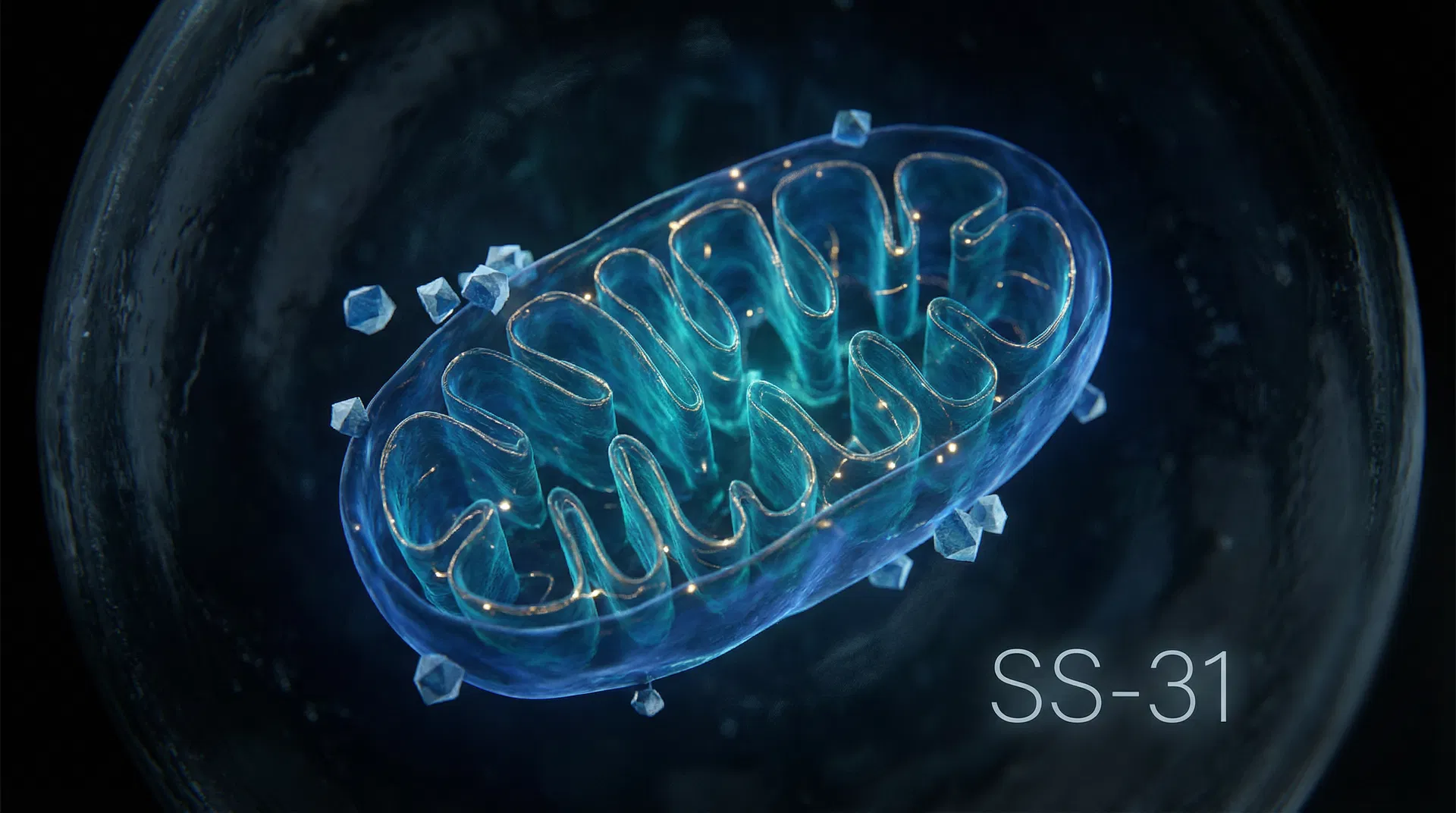
SS-31 (Elamipretide) is a mitochondria-targeting tetrapeptide that selectively binds cardiolipin on the inner mitochondrial membrane, stabilising cristae structure, reducing oxidative stress, and enhancing ATP production. Search interest has surged +70% in 2026 as longevity researchers focus on mitochondrial dysfunction as a root cause of aging.
Research Use Only. This article is for informational and research purposes only and does not constitute medical advice. Always consult a qualified healthcare professional before making any health decisions.
What Is SS-31 Peptide?
SS-31 — formally known as Elamipretide, and also referenced in the literature as MTP-131 and Bendavia — is a synthetic tetrapeptide developed by Dr. Hazel Szeto and Dr. Peter Schiller at Weill Cornell Medical College. Its full amino acid sequence is D-Arg-Dmt-Lys-Phe-NH₂, where Dmt denotes 2′,6′-dimethyltyrosine, a modified aromatic residue that contributes both antioxidant capacity and structural stability to the molecule.
The compound belongs to the Szeto-Schiller (SS) family of mitochondria-targeting peptides, a class distinguished by their ability to selectively concentrate within the inner mitochondrial membrane without requiring a membrane potential gradient for uptake — a property that sets them apart from earlier mitochondria-targeted antioxidants such as MitoQ. This characteristic makes SS-31 active even in severely dysfunctional mitochondria where membrane potential has collapsed, which is precisely the condition found in ischemic and aged tissues.
Since its initial characterisation in the early 2000s, SS-31 has accumulated one of the most substantial preclinical evidence bases of any mitochondria-targeted peptide, spanning cardiovascular disease, renal injury, neurodegeneration, skeletal muscle atrophy, and age-related decline. It is currently in Phase II clinical trials for multiple indications and received FDA approval in 2024 under the brand name FORZINITY™ for Barth syndrome — a rare mitochondrial cardiomyopathy.
Why SS-31 Is Generating Significant Research Interest in 2026
Search interest in SS-31 has increased by over 70% in the United States in early 2026, with "ss-31 peptide dosage" ranking as the single highest-volume related query. This surge coincides with several converging developments in longevity science and mitochondrial medicine.
The first is the broader recognition of mitochondrial dysfunction as a root cause of aging rather than merely a consequence of it. Research has established that the decline in mitochondrial cristae integrity, cardiolipin oxidation, and electron transport chain efficiency are among the earliest measurable changes in aging cells — preceding many downstream pathologies previously considered primary.
The second is the FDA approval of Elamipretide for Barth syndrome in 2024, which brought significant mainstream scientific attention to the compound and validated the broader SS peptide research programme. The TAZPOWER clinical trial demonstrated sustained improvements in skeletal muscle strength, cardiac stroke volume, and fatigue scores over a 168-week open-label extension period.
The third is the growing interest in peptide stacks for longevity and performance research, with SS-31 increasingly appearing alongside compounds such as BPC-157, TB-500, and NAD+ precursors in research protocol literature.
Mechanism of Action: How SS-31 Targets the Mitochondria
Cardiolipin Binding
The primary mechanism of SS-31 centres on its interaction with cardiolipin, a structurally unique phospholipid found almost exclusively in the inner mitochondrial membrane. Cardiolipin has a distinctive four-acyl-chain architecture that is essential for maintaining the curvature of mitochondrial cristae — the folded inner membrane structures where the electron transport chain (ETC) complexes are assembled and ATP synthesis occurs.
During cellular stress, ischemia, or normal aging, cardiolipin undergoes oxidative damage. This oxidation disrupts cristae architecture, impairs ETC complex assembly, and triggers the translocation of cytochrome c from the inner membrane to the cytoplasm — a key initiating event in the intrinsic apoptotic pathway. The result is a cascade of mitochondrial dysfunction that reduces ATP output, increases reactive oxygen species (ROS) production, and accelerates cell death.
SS-31 binds cardiolipin through a combination of electrostatic and hydrophobic interactions. Its two positively charged residues (D-Arg and Lys) are attracted to the negatively charged phosphate groups of cardiolipin, while its aromatic residues (Phe and Dmt) insert into the lipid bilayer. This binding stabilises cardiolipin against oxidation, preserves cristae structure, and prevents the release of cytochrome c.
Enhancement of Electron Transport Chain Function
By stabilising cardiolipin, SS-31 promotes the proper assembly and activity of ETC Complexes I, III, and IV. This enhancement facilitates more efficient electron transfer and ATP synthesis, directly addressing the energy deficits that characterise mitochondrial dysfunction in aged and diseased tissues. Preclinical studies have demonstrated that SS-31 treatment restores ATP levels in ischemic renal and cardiac tissue within hours of administration.
Reduction of Mitochondrial Reactive Oxygen Species
Improved ETC efficiency reduces electron leakage — the primary source of mitochondrial ROS production. By tightening the coupling of electron transfer to ATP synthesis, SS-31 reduces the generation of superoxide and hydrogen peroxide within the mitochondrial matrix. This reduction in ROS production creates a positive feedback loop: less oxidative damage to cardiolipin means better ETC function, which means less ROS, which means less cardiolipin damage.
Inhibition of the Mitochondrial Permeability Transition Pore
The mitochondrial permeability transition pore (mPTP) is a channel that opens under conditions of oxidative stress and calcium overload, leading to mitochondrial swelling, membrane depolarisation, and the release of pro-apoptotic factors. SS-31 inhibits mPTP opening by maintaining cardiolipin integrity and mitochondrial membrane potential, providing protection against ischemia-reperfusion injury.
| Mechanism | Effect | Research Context | |---|---|---| | Cardiolipin binding | Stabilises inner mitochondrial membrane | Cardiac, renal, neuronal models | | ETC complex stabilisation | Increases ATP production | Heart failure, ischemia models | | ROS reduction | Reduces oxidative damage | Aging, diabetes, neurodegenerative models | | mPTP inhibition | Prevents apoptotic cascade | Ischemia-reperfusion injury models | | Cytochrome c retention | Blocks intrinsic apoptosis | Multiple disease models |
Preclinical Research Summary
Cardiovascular Models
The cardiovascular research on SS-31 is among the most extensive in the preclinical literature. A landmark study using a canine model of advanced heart failure found that chronic subcutaneous administration of Elamipretide significantly increased ejection fraction, stroke volume, and cardiac output, while reducing left ventricular end-diastolic pressure and systemic vascular resistance. These improvements were accompanied by normalisation of heart failure biomarkers, reversal of mitochondrial dysfunction, and reduction in cardiomyocyte hypertrophy and interstitial fibrosis.
In post-myocardial infarction rat models, chronic SS-31 therapy improved cardiac function and prevented left ventricular remodelling, in part by preserving SERCA2a activity — a calcium pump whose depression is a major driver of heart failure progression.
Renal Disease Models
In murine models of ischemia-reperfusion kidney injury, SS-31 administration reduced oxidative stress, restored ATP levels, and protected mitochondrial structure, leading to decreased kidney injury markers and reduced fibrosis. In diabetic nephropathy models, the compound protected renal mitochondrial structure against chronic hyperglycaemia-induced damage and slowed the progression of kidney fibrosis.
Neurodegenerative Disease Models
In Alzheimer's disease mouse models, SS-31 treatment recovered mitochondrial function in neural tissue and increased neurite outgrowth, indicating protection against amyloid-beta toxicity. In Parkinson's disease models, SS-31 produced dose-dependent protection of dopaminergic neurons from oxidative damage and mitochondrial dysfunction.
Skeletal Muscle and Aging
A 2013 study published in Aging Cell demonstrated that SS-31 rapidly improved mitochondrial function in aged skeletal muscle, reversing age-related deficits in muscle energetics. The authors concluded that SS-31 represented a new strategy for addressing age-related declines in skeletal muscle performance with potential for translation to human research.
Clinical Trials
| Trial | Design | Key Findings | |---|---|---| | EMBRACE-STEMI | Phase 2a, STEMI patients undergoing PCI. Dose: 0.05 mg/kg/h for 1 hour. | No reduction in infarct size, but reduced incidence of chronic heart failure within 24 hours post-PCI. | | PROGRESS-HF | Phase 2, stable HFrEF patients. Dose: 4 mg or 40 mg. | Primary endpoint (LVESV reduction) not met; improvements in mitochondrial function and quality of life observed. | | TAZPOWER | Randomised, double-blind, crossover in Barth syndrome + 168-week open-label extension. Dose: 40 mg. | Significant improvements in skeletal muscle strength, cardiac stroke volume, fatigue scores, and cardiac parameters. Sustained over 168 weeks. | | MMPOWER-3 | Phase 3, primary mitochondrial myopathy. Dose: 40 mg. | Primary endpoint not met; subgroup analyses suggested benefit in patients with greater baseline impairment. | | ReCLAIM | Phase 2, age-related macular degeneration. | Ongoing; SS-31 is in Phase II for AMD based on its ability to protect retinal mitochondria. |
Safety Profile
Multiple clinical trials have demonstrated a favourable tolerability profile for Elamipretide. The most commonly reported adverse events are mild and transient injection site reactions, including localised pain, redness, and swelling. Less common events include mild to moderate headaches, dizziness, nausea, and fatigue. No clinically significant differences in vital signs, laboratory values, physical examination findings, or ECG parameters were observed across trials, including the 168-week open-label extension of the TAZPOWER study.
Reconstitution and Storage for Research Use
SS-31 is supplied by Pure Peptides in lyophilised (freeze-dried) powder form, which provides maximum stability during storage and shipping.
Reconstitution: SS-31 is water-soluble and can be reconstituted in sterile bacteriostatic water or sterile saline. A standard reconstitution approach for a 10 mg vial is to add 1–2 mL of bacteriostatic water to yield a concentration of 5–10 mg/mL. The vial should be gently swirled — not shaken — until the powder is fully dissolved.
Storage: Lyophilised SS-31 should be stored at −20°C and protected from light. Once reconstituted, the solution should be stored at 4°C and used within 28 days. Repeated freeze-thaw cycles should be avoided; aliquoting into single-use volumes before freezing is recommended for longer-term storage.
Purity: All Pure Peptides SS-31 is HPLC-verified at ≥98% purity and supplied with a Certificate of Analysis confirming identity and purity for each batch.
Frequently Asked Questions
What is the difference between SS-31 and SS-20? SS-20 (Phe-D-Arg-Phe-Lys-NH₂) is another member of the Szeto-Schiller peptide family. While both target cardiolipin on the inner mitochondrial membrane, SS-31 contains the Dmt residue which provides additional antioxidant capacity through its electron-scavenging aromatic ring. SS-31 has a substantially larger evidence base and is the compound in active clinical development.
What is the difference between SS-31 and Elamipretide? They are the same compound. SS-31 is the research designation; Elamipretide is the INN (International Nonproprietary Name) used in clinical and regulatory contexts. FORZINITY™ is the brand name under which it received FDA approval for Barth syndrome in 2024.
Is SS-31 the same as MTP-131? Yes. MTP-131 was an earlier designation used by Stealth Biotherapeutics. All three names — SS-31, Elamipretide, and MTP-131 — refer to the same tetrapeptide compound with the sequence D-Arg-Dmt-Lys-Phe-NH₂.
What does "lyophilised" mean? Lyophilisation is a freeze-drying process that removes water from the peptide under vacuum conditions. The resulting powder is highly stable at low temperatures and has a significantly longer shelf life than a liquid solution. Reconstitution with sterile water restores the peptide to its active form.
All compounds are sold for laboratory research use only. Not for human consumption, injection, or therapeutic application. Researchers are responsible for compliance with all applicable institutional and regulatory guidelines.