
Bacteriostatic Water for Peptides: A Complete Reconstitution Guide
Bacteriostatic water is the preferred diluent for most research peptides — but using the wrong solvent is one of the most common errors that compromises peptide integrity. This guide covers what BAC water is, why it matters, and the correct step-by-step reconstitution protocol.
Research Use Only. This article is for informational and research purposes only and does not constitute medical advice. Always consult a qualified healthcare professional before making any health decisions.
What Is Bacteriostatic Water?
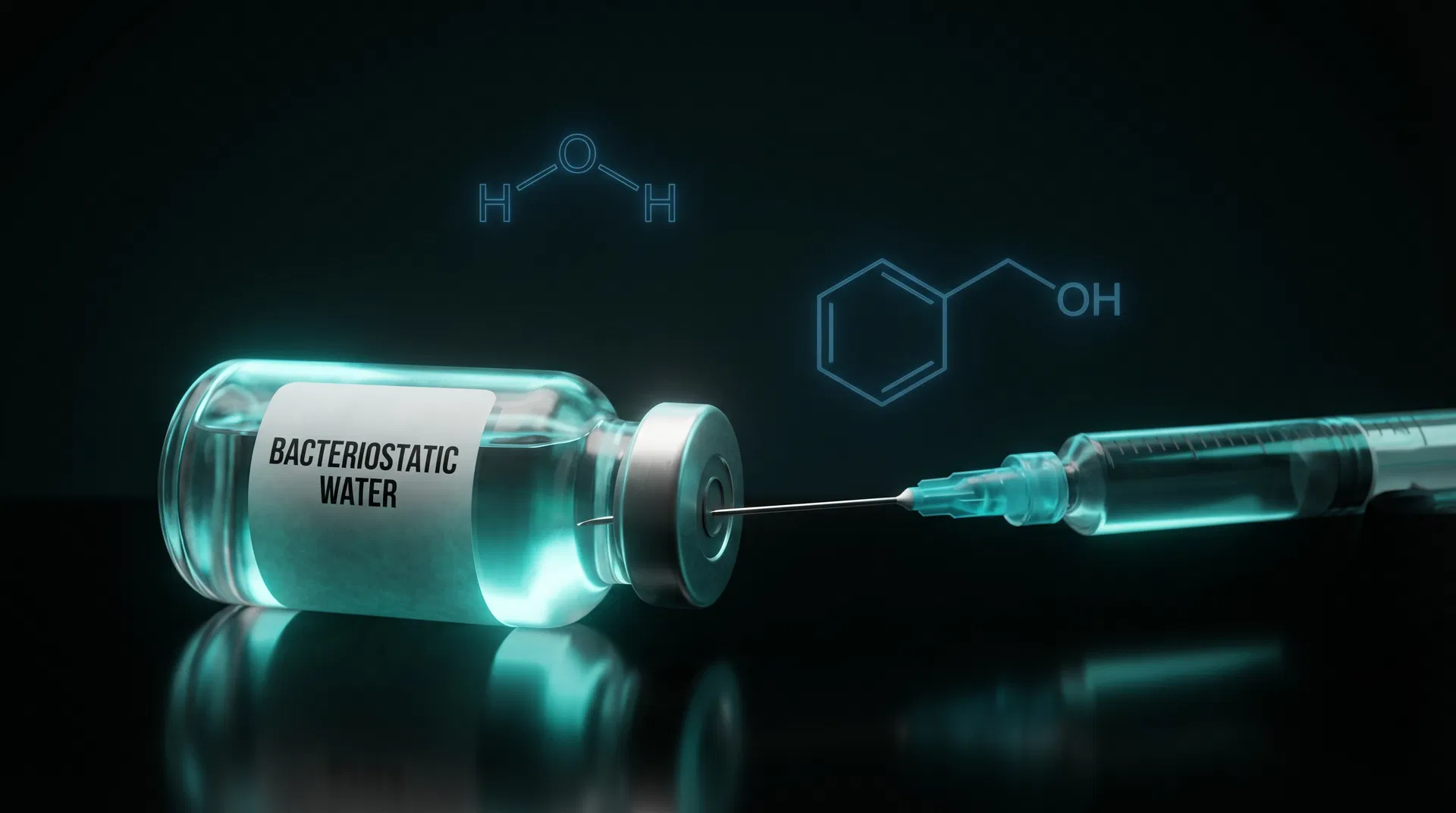
Bacteriostatic water (BAC water) is sterile water for injection that contains 0.9% benzyl alcohol as a preservative. The benzyl alcohol inhibits the growth of most bacteria, which is why the solution is described as "bacteriostatic" rather than "sterile" — it does not kill organisms already present, but prevents new growth. This property allows a single vial to be used for multiple draws over an extended period (typically up to 28 days after first puncture) without the microbial contamination risk that would accompany repeated access to plain sterile water.
It is distinct from several other common diluents:
| Diluent | Preservative | Multi-use | Typical Use | |---|---|---|---| | Bacteriostatic water | 0.9% benzyl alcohol | Yes (up to 28 days) | Peptide reconstitution | | Sterile water for injection | None | No (single use only) | Single-dose reconstitution | | Normal saline (0.9% NaCl) | None | No | IV/IM dilution | | Bacteriostatic saline | 0.9% benzyl alcohol + NaCl | Yes | Some protein formulations |
Why Bacteriostatic Water Is Preferred for Peptides
Most research-grade peptides are supplied as lyophilised (freeze-dried) powders to maximise shelf life. Reconstitution requires a diluent that will dissolve the powder without denaturing the peptide structure, maintain stability over the intended storage period, and minimise contamination risk across multiple uses.
Bacteriostatic water satisfies all three criteria for the majority of peptides. The benzyl alcohol preservative does not react with peptide bonds or disrupt secondary structure at the 0.9% concentration used. It keeps the reconstituted solution stable for up to 28 days under refrigeration, which aligns with typical research dosing schedules. And the multi-use nature of the vial reduces the number of punctures required compared to single-use sterile water vials, lowering contamination risk per dose.
Step-by-Step Reconstitution Protocol
The following protocol applies to standard lyophilised peptides supplied in sealed vials.
Materials required: Lyophilised peptide vial, bacteriostatic water vial, insulin syringe (1 mL, 29–31 gauge), alcohol swabs, permanent marker.
Step 1 — Calculate your target concentration. Determine the desired concentration in mg/mL or mcg/mL based on your research protocol. A common starting point for many peptides is 1–2 mg/mL. For a 5 mg peptide vial reconstituted to 1 mg/mL, you will add 5 mL of bacteriostatic water.
Step 2 — Swab all surfaces. Wipe the rubber septum of both the peptide vial and the bacteriostatic water vial with a fresh alcohol swab. Allow to air-dry for 30 seconds.
Step 3 — Draw the bacteriostatic water. Insert the syringe into the bacteriostatic water vial and withdraw the calculated volume.
Step 4 — Add water to the peptide vial slowly. Insert the syringe into the peptide vial and direct the stream of water against the inside wall of the vial rather than directly onto the powder. This minimises foaming and mechanical disruption of the peptide structure.
Step 5 — Dissolve gently. Do not shake. Roll the vial gently between your palms or allow it to sit at room temperature for 5–10 minutes. Most peptides will dissolve completely without agitation.
Step 6 — Label and store. Mark the vial with the date of reconstitution, concentration, and peptide name. Store at 2–8°C (standard refrigerator temperature). Use within 28 days.
Common Mistakes to Avoid
Using sterile water for multi-dose vials. Without a preservative, a vial accessed multiple times is at significant risk of microbial contamination. Sterile water should only be used when the entire reconstituted volume will be used in a single session.
Injecting water directly onto the powder. Directing the stream onto the lyophilised cake can cause mechanical denaturation and foaming, both of which reduce peptide bioavailability and make accurate dosing more difficult.
Storing reconstituted peptides at room temperature. Peptide bonds are susceptible to hydrolysis at elevated temperatures. Reconstituted solutions should always be refrigerated, not left on a bench.
Freeze-thaw cycling. Reconstituted peptide solutions should not be frozen. If long-term storage is required, the peptide should remain in lyophilised form and reconstituted fresh.
Important Disclaimer
This guide is provided for educational and research purposes only. Feel Pure Peptides supplies bacteriostatic water and peptide compounds exclusively for legitimate research applications. All handling and use must comply with applicable institutional and regulatory requirements.
Last updated: April 2026 | Author: Feel Pure Peptides Research Team